AI in Geotechnical Engineering: A New Innovation from the Doctoral Program in Civil Engineering at the Faculty of Engineering, University of Hasanuddin, to Improve the Efficiency of Soil Investigations
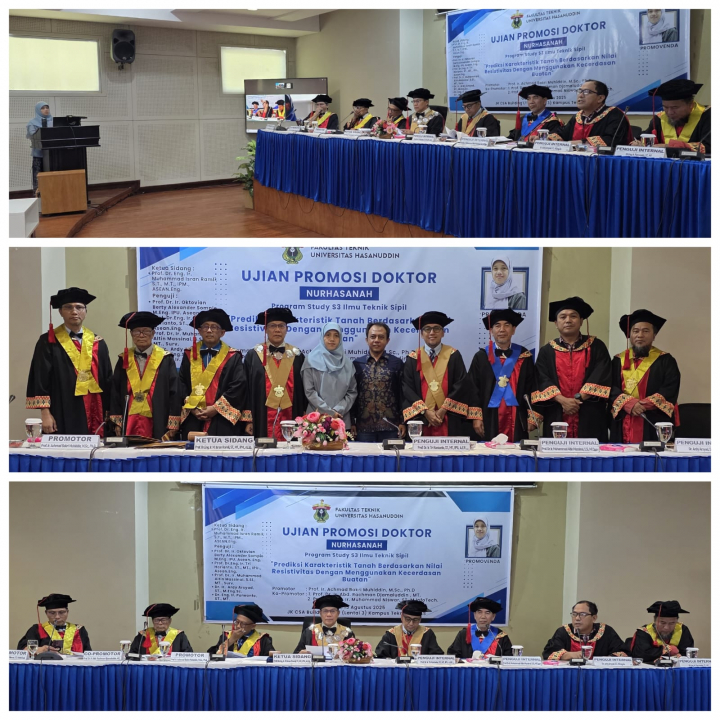
Gowa, August 15, 2025 – The Faculty of Engineering at Hasanuddin University (FT-UH) has once again conferred a Doctor of Civil Engineering degree through an Open Doctoral Defense held at the FT-UH Campus in Gowa. The dissertation research examined at this session offers a breakthrough in the field of geotechnical engineering by utilizing Artificial Intelligence (AI) technology to predict soil characteristics more efficiently, cost-effectively, and with minimal invasive testing.
This open defense was presided over by the Dean of the Faculty of Engineering at Unhas, Prof. Dr. Eng. Ir. Muhammad Isran Ramli, S.T., M.T., IPM., ASEAN.Eng., who served as Chair of the Defense and represented the Rector of Hasanuddin University. Also present were the dissertation advisor, co-advisors, and examiners, including the advisor Prof. Ir. Achmad Bakri Muhiddin, M.Sc., Ph.D., co-advisors Prof. Dr. Ir. Abd. Rachman Djamaluddin, MT, and Prof. Dr. Eng. Ir. Muhammad Niswar, ST., M.InfoTech; external examiner Prof. Dr. Ir. Oktovian Berty Alexander Sompie, M.Eng., IPU., ASEAN.Eng., who is also the Rector of Sam Ratulangi University; and internal examiners Prof. Dr. Eng. Ir. Tri Harianto, ST., MT., IPU., ASEAN. Eng.; Prof. Dr. Ir. Muhammad Altin Massinai, S.Si., MT. Surv.; Dr. Ardy Arsyad, ST., M.Eng.Sc.; and Dr. Eng. Ir. Purwanto, ST., MT.
The dissertation focused on developing a model for classifying and predicting subsurface soil characteristics by integrating geelectrical resistivity, Cone Penetration Test (CPT), and borehole data, which were then processed using machine learning algorithms such as K-Nearest Neighbor (KNN), Random Forest (RF), and Extreme Gradient Boosting (XGBoost). The results of this research open new opportunities to accelerate the soil investigation process for foundation design and infrastructure development, while reducing the costs and time required for field testing.
Based on the examination results and the evaluation committee’s deliberations, the doctoral candidate was declared to have passed with the grade “Highly Satisfactory” and officially holds the degree of Doctor of Civil Engineering.
In his remarks, the advisor, Prof. Ir. Achmad Bakri Muhiddin, M.Sc., Ph.D., stated that this research demonstrates progress in integrating cutting-edge digital technology into the field of civil engineering, particularly geotechnical engineering. According to him, the use of AI to predict soil characteristics not only improves accuracy and efficiency but can also serve as a model for sustainable soil investigation in the future.
“This approach can be a suitable alternative in infrastructure planning, reducing reliance on invasive testing, and accelerating the decision-making process,” he said.