FT Unhas Students Win Medals at PIMNAS 39, Contributing to Unhas's Continued Overall Championship
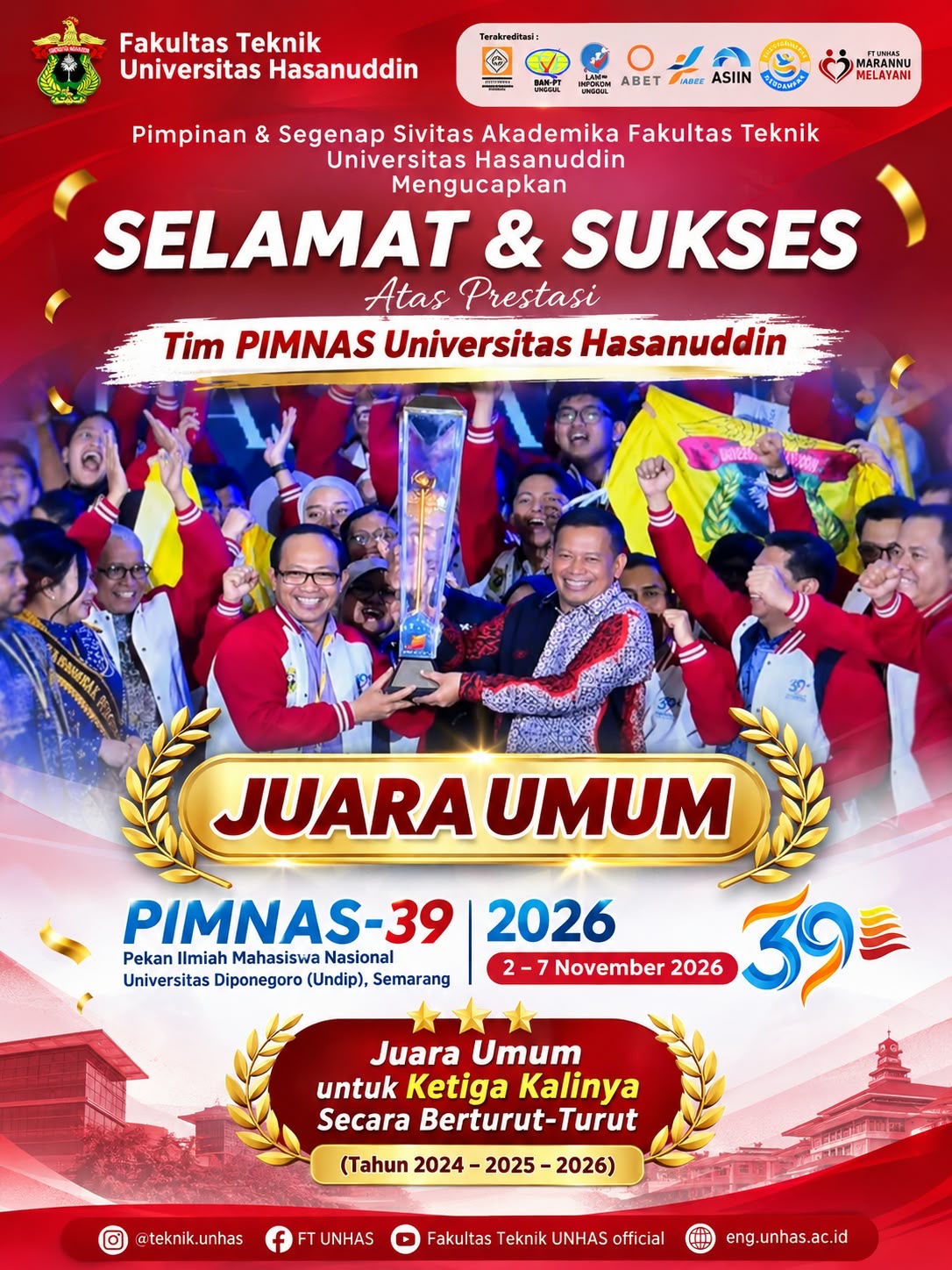
Gowa, November 7, 2026 – Students of the Faculty of Engineering, Hasanuddin University (FT Unhas), once again demonstrated outstanding achievements at the 39th National Student Scientific Week (PIMNAS) 2026, held from November 2 to 7, 2026, at Diponegoro University in Semarang. Several FT Unhas students received awards for their research and innovations, ranging from social research and botanical pesticide development to technological applications. These achievements contributed to Hasanuddin University's success in retaining the PIMNAS Overall Championship for three consecutive years, namely 2024, 2025, and 2026.
These accomplishments reflect the strengthening of research culture, creativity, innovation, and multidisciplinary collaboration within the Faculty of Engineering. The students' achievements are demonstrated not only through their medal-winning performances but also through scientific ideas addressing real societal challenges and developing innovative solutions capable of competing at the national level.
Team Moonlighting: Examining the Vulnerability of Gig Economy Workers
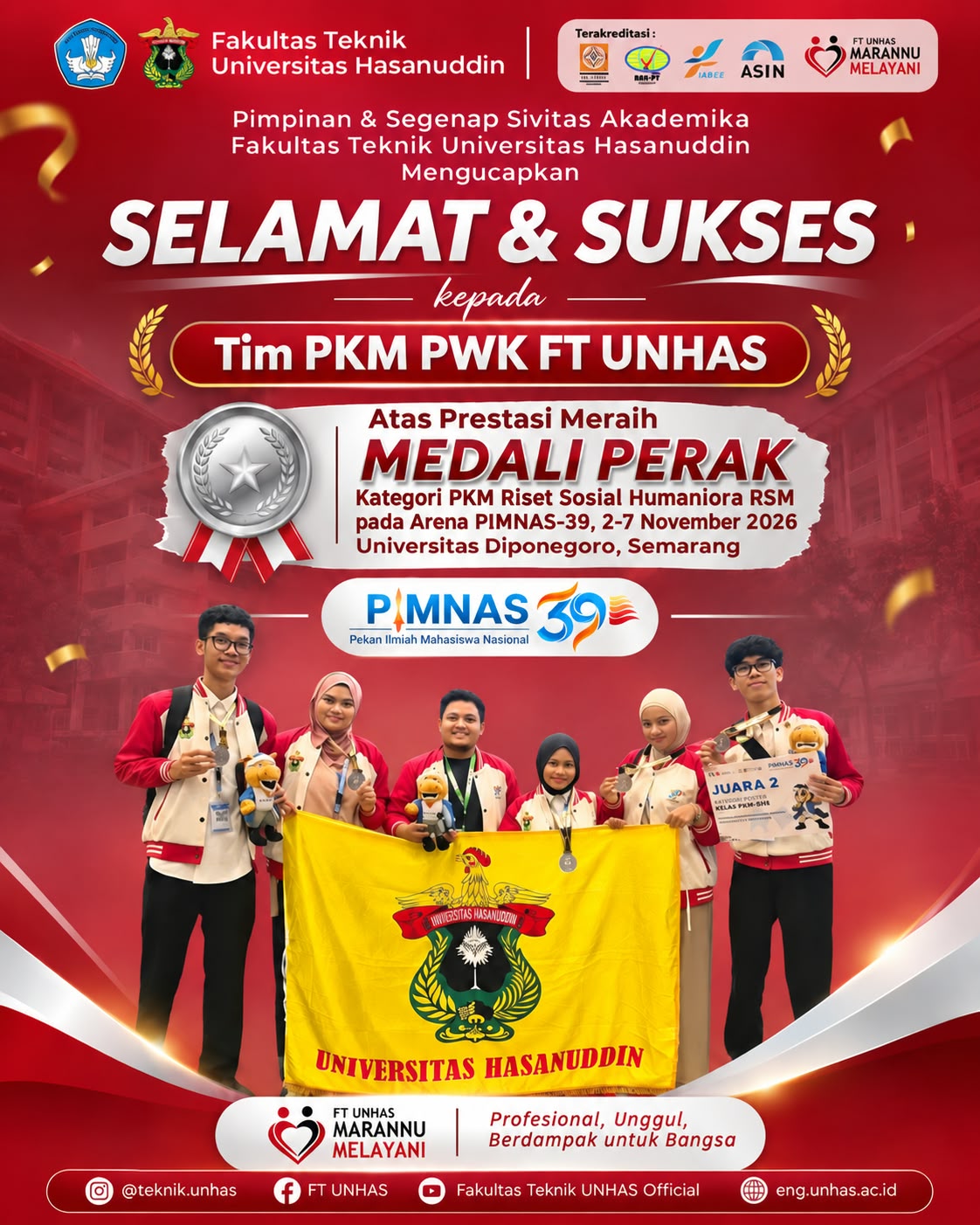
One of the notable achievements was earned by Team Moonlighting, which competed in the Social Humanities Research (RSH) category. The team presented a research project entitled “Moonlighting Phenomenon: An Analysis of Online Drivers' Vulnerability and Adaptation Strategies in the Gig Economy through the Perspective of Multiple Job Holding Theory.”
Team Moonlighting consists of Bima Cakrawala M. (Urban and Regional Planning Study Program), Saskia Ramadhany (Urban and Regional Planning Study Program), Rasya Perdana Ramadhan (Urban and Regional Planning Study Program), Auralia Putri Rosalina R. (Development Economics Study Program), and Nurul Fahira (Sociology Study Program). The research was supervised by Muhammad Irfan, S.T., M.Sc.
Using a multidisciplinary approach, the research examines the phenomenon of online transportation drivers engaging in multiple jobs or economic activities. The Multiple Job Holding Theory perspective is employed to understand the vulnerabilities experienced by gig economy workers and their adaptation strategies in response to increasingly flexible employment dynamics.
The study highlights the importance of collaboration among urban and regional planning, development economics, and sociology in comprehensively understanding urban social issues.
For this research, Team Moonlighting secured Second Place, equivalent to a Silver Medal, in the Poster Category of the RSH Division.
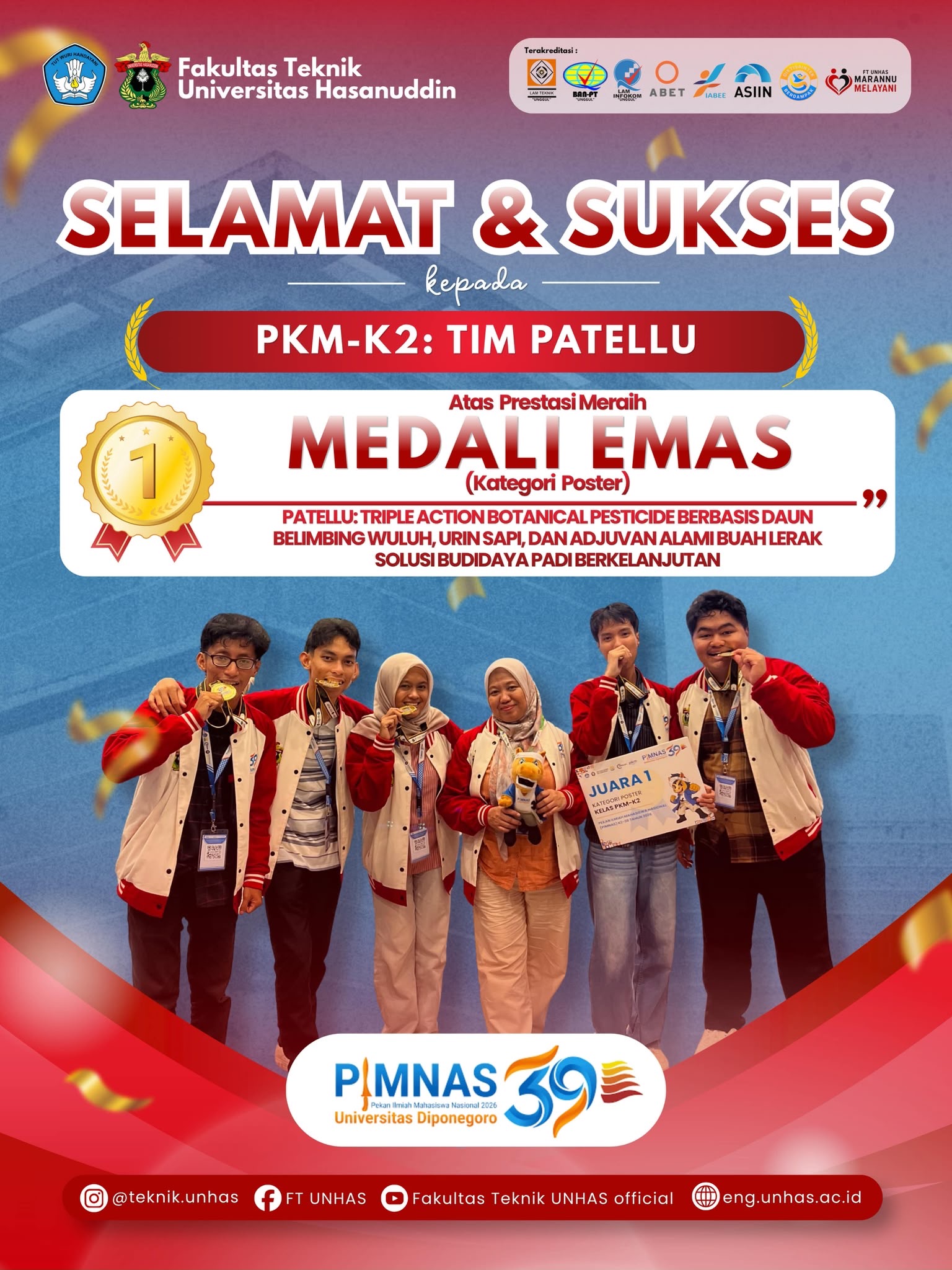
PATELLU: Botanical Pesticide Innovation for Sustainable Agriculture
Another achievement was earned by A. Rangga Dwi Adithya from the Environmental Engineering Study Program, who won First Place, equivalent to a Gold Medal, in the Poster Category of PKM-K2.
Rangga developed a research project entitled “PATELLU: Triple-Action Botanical Pesticide Based on Bilimbi Leaves, Cow Urine, and a Natural Surfactant from Soapberry Fruit as a Solution for Sustainable Rice Cultivation.”
The research proposes the development of botanical pesticides using natural ingredients, namely bilimbi leaves, cow urine, and soapberry fruit. This innovation has the potential to provide an alternative approach to supporting more sustainable agricultural practices through the utilization of natural resources.
The project demonstrates how environmental engineering students can integrate environmental knowledge, natural material utilization, and agricultural needs into an innovation-oriented initiative designed to deliver practical benefits.
Aquatron: Integrating Technology and Animal Welfare
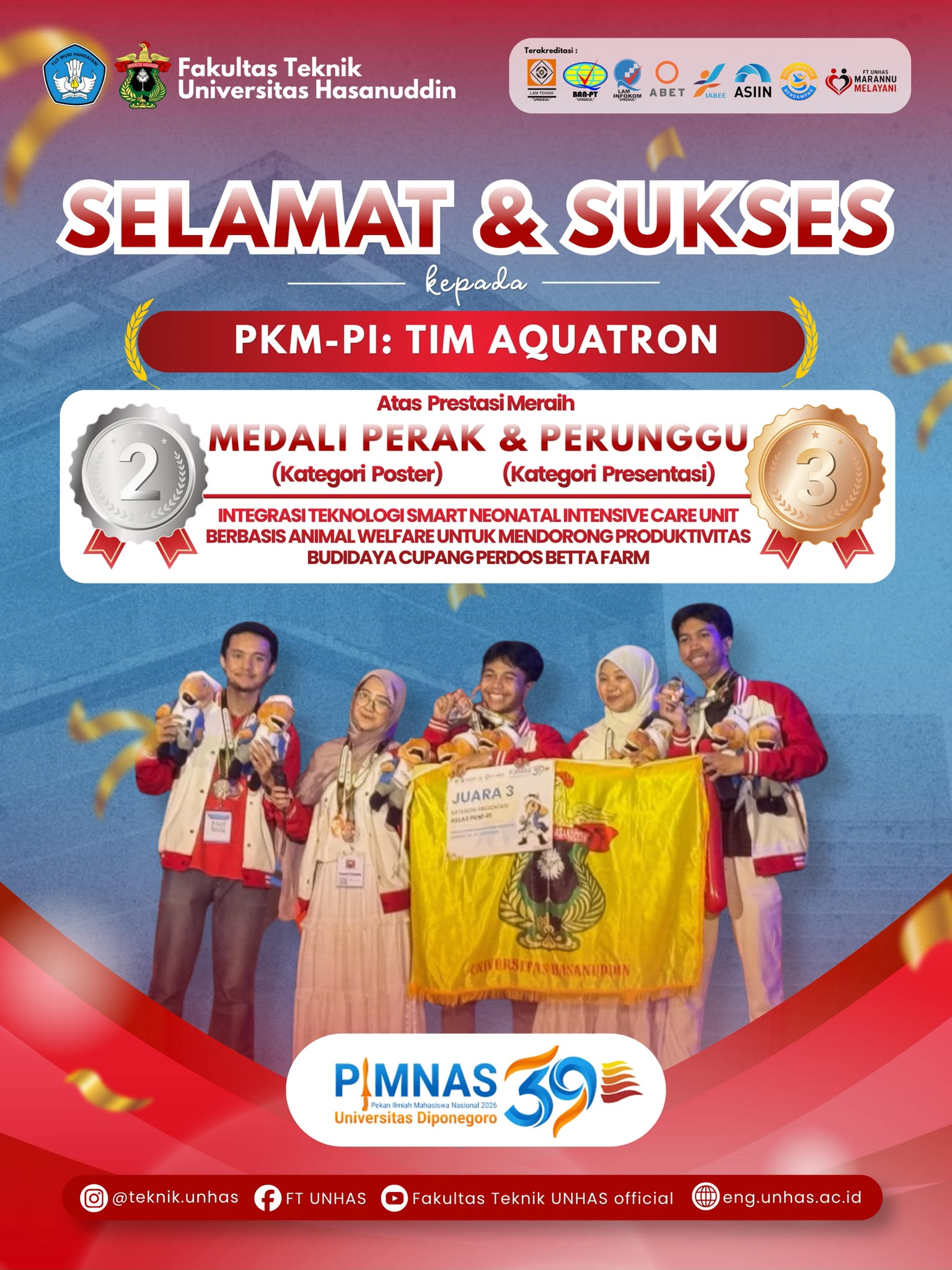
Multidisciplinary collaboration was also demonstrated by Team Aquatron through its research entitled “Integration of Smart Neonatal Intensive Care Unit Technology Based on Animal Welfare to Enhance the Productivity of Betta Fish Farming at Perdos Betta Farm.”
Team Aquatron consists of Fatir Husnul Umam (Veterinary Medicine Study Program), Syahidatul Jannah (Veterinary Medicine Study Program), Muh. Nayaka Habsyi (Electrical Engineering Study Program), Ishmah Nurwasilah (Information Systems Study Program), and Muh. Anwar (Management Study Program).
The team received Second Place, equivalent to a Silver Medal, in the Poster Category and Third Place, equivalent to a Bronze Medal, in the Presentation Category of the PKM-Science and Technology Implementation (PKM-PI) Division.
Aquatron's concept demonstrates the integration of veterinary medicine, electrical engineering, information systems, and management in developing technology that supports animal welfare and aquaculture productivity. This approach illustrates how technological innovation can emerge through collaboration across disciplines to address the needs of productive sectors.
Team Oscar: Creative Innovation through Informatics Technology
In the Student Creativity Program–Creation (PKM-KC) category, Team Oscar also contributed to the university's achievements through an innovative project developed by students from the Informatics Engineering Study Program.
The team consists of Rifaldi (Informatics Engineering Study Program) and Yazid Nursyafiqi (Informatics Engineering Study Program). Both students achieved Second Place, equivalent to a Silver Medal, in the Presentation Category and Third Place, equivalent to a Bronze Medal, in the Poster Category of PKM-KC.
These achievements demonstrate the students' ability to develop technology-based creative ideas while effectively communicating their innovations through scientific presentations and posters. The competition also provides an opportunity for students to strengthen their critical thinking, problem-solving, and academic communication skills.
Collaboration and Research Mentoring as the Foundation of Achievement
The series of achievements earned by FT Unhas students at PIMNAS 39 demonstrates that research and innovation development requires a supportive academic ecosystem. Faculty mentoring, cross-study-program collaboration, and continuous research guidance are essential components in producing competitive scientific work.
The involvement of Urban and Regional Planning students alongside students from development economics and sociology in Team Moonlighting illustrates how societal challenges require multidisciplinary approaches. Meanwhile, PATELLU and Aquatron demonstrate how engineering knowledge can contribute to sustainable agricultural solutions and technologies grounded in animal welfare.
At the institutional level, Hasanuddin University's success in winning the Overall Championship at PIMNAS 39 in 2026 and maintaining this achievement for three consecutive years represents a strategic milestone. It further reinforces Unhas's commitment to strengthening its reputation in student creativity and innovation at the national level.
The Faculty of Engineering, Hasanuddin University, extends its appreciation to all participating students, supervising lecturers, and supporting teams for their contributions and dedication to these achievements. These accomplishments are expected to inspire students to continue advancing research, developing impactful innovations, and strengthening multidisciplinary collaboration.
Moving forward, FT Unhas remains committed to fostering an innovative, competitive, and solution-oriented academic culture. Through strengthened student research initiatives and continuous mentoring, scientific work is expected to go beyond competition achievements and evolve into applicable innovations that deliver tangible benefits to society.