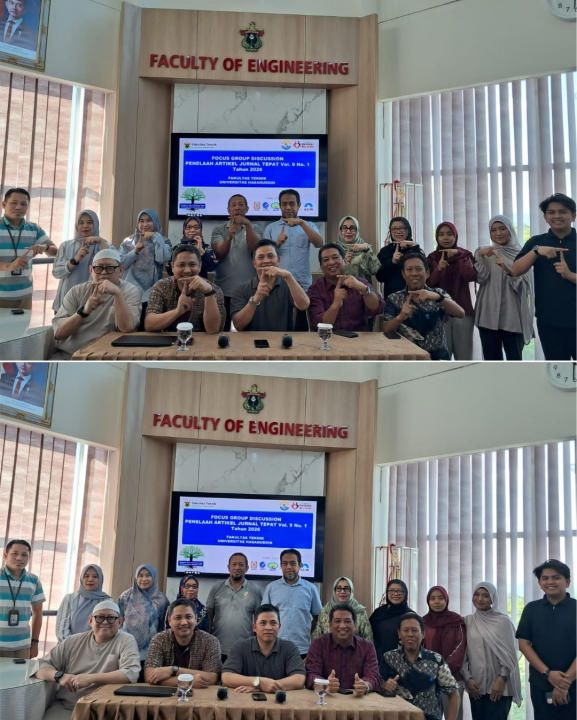
FGD on the TEPAT Journal, Faculty of Engineering, University of Hasanuddin: Strengthening the Dissemination and Commercialization of Research Findings through Impactful Community Service
The Faculty of Engineering at Hasanuddin University (FT Unhas) has once again reaffirmed its commitment to strengthening the commercialization of research and making tangible contributions to society through the holding of a Focus Group Discussion (FGD) for reviewers of articles in the journal TEPAT (Applied Technology for Community Service), Volume 9, Number 1, Year 2026. This two-day academic event, held on June 27–28, 2026, took place on the campus of the Faculty of Engineering, Hasanuddin University. The FGD was designed to thoroughly review, evaluate, and standardize the quality of community service articles ready for publication in order to generate broader and more sustainable socioeconomic impacts.
The event was officially opened by the Associate Dean for Partnerships, Research, Innovation, and Alumni at the Faculty of Engineering, Hasanuddin University, Prof. Muhammad Bachtiar Nappu, Ph.D. In his remarks, he expressed high appreciation for the consistency of the TEPAT Journal, which continues to serve as a platform for high-quality scientific publications for community service programs from various universities in Indonesia. He emphasized that the role of reviewers is crucial in maintaining the faculty’s academic reputation and ensuring that every commercialized technology possesses high levels of novelty and practical utility within the community.
“The Faculty of Engineering at Unhas consistently encourages community service outcomes not to remain merely on paper, but to take the form of practical, appropriate technological innovations. Through this reviewer focus group discussion, we are refining and sharpening the narrative of these contributions so that they become an inspiring national reference,” said Prof. Muhammad Bachtiar Nappu, Ph.D.
Led directly by the Editor-in-Chief of the TEPAT Journal, Prof. Muh. Anshar, ST., M.Sc-Res., Ph.D., this forum intensively reviewed 20 scientific articles that had successfully passed the selection process for publication in Volume 9, Issue 1, 2026. Prof. Muh. Anshar explained that this review process focused on the strength of participatory methodologies, the precision of instrument design, and the accuracy of measuring the impact of community service activities through scientific approaches such as the use of pre-test and post-test instruments.
“Among the 20 published articles, there is a rich diversity of community service focuses, ranging from agricultural mechanization, renewable energy management, the digitization of MSMEs, to the preservation of geological reserves. Reviewers are tasked with ensuring that every article meets strict scientific journal writing standards, while also highlighting the multidisciplinary collaboration that is the essence of community service," explained Prof. Muh. Anshar in his report.
This Volume 9, Issue 1, 2026 edition features significant contributions from faculty members and internal researchers within the Department of the Faculty of Engineering at Hasanuddin University, in addition to collaborations with partner universities such as the University of Riau, Nusa Cendana University, and Makassar State University. The presence of these articles reflects the high value placed on inter-institutional collaboration for mutual progress.
Several featured articles reviewed in this FGD clearly showcase appropriate technological innovations that directly address fundamental challenges in the field. One notable contribution came from the Department of Mining Engineering at the Hasanuddin University Faculty of Engineering through the “Training Program on Identifying Mineral and Rock Characteristics for Geology-Mining Students at Barru State Vocational High School No. 5.” This collaborative program, based on Laboratory-Based Education (LBE), successfully improved the practical readiness of vocational high school students significantly, as evidenced by a surge in the average competency scores of participants from 52 to 72.
Innovations in the agricultural sector and rural mechanization also dominated this issue. The Department of Mechanical Engineering at FT Unhas contributed two exceptional implementable research studies. First, the implementation of a Solar Charge Station (SCS) for recharging electric sprayer batteries in Bone Regency, initiated by Prof. Dr. Ir. Nasaruddin Salam, MT., along with his team, which successfully educated local farmer groups on how to independently utilize renewable solar energy. Second, a study on “Innovations in Corn Choppers as an Efficient Solution for Livestock Feed in Kading Village, Barru Regency” by Zulkifli Djafar and his team, which succeeded in reducing the time required for chopping by up to 60% and producing much more uniform feed particle sizes for local livestock farmers.
Not to be outdone, the Department of Computer Engineering at the Faculty of Engineering, University of Hasanuddin (Unhas), has tactically responded to the era of digital transformation through a strategic branding program based on AI-Driven Marketing Content for the Bolu Pisang SME in Polewali Mandar Regency. This hands-on workshop, led by Novy NRA Mokobombang, equipped micro-entrepreneurs with prompt engineering skills using artificial intelligence to boost the visual competitiveness of local products on e-commerce platforms such as Shopee. A similar impact was observed in a community service article by the Department of Architecture at the Faculty of Engineering, University of Hasanuddin (Unhas), which developed design recommendations for disability-friendly communal spaces in the Unhas Antang residential area, resulting in a 60% increase in residents’ understanding of the importance of an inclusive environment.
The conclusion of this series of focus group discussions (FGDs) was marked by the formulation of periodic improvement recommendations to strengthen the TEPAT Journal toward higher indexing and expand its readership. Through the standardization of increasingly professional peer review quality, the Faculty of Engineering at Hasanuddin University is optimistic that the TEPAT Journal can continue to serve as a national barometer for solution-oriented applied technology publications.
High hopes are pinned on the fact that all published community service works will trigger a more massive domino effect: fostering rural economic independence, stimulating the emergence of smart MSMEs, and strengthening the circular economy ecosystem across various regions in Indonesia. This initiative aligns with Hasanuddin University’s vision as a center for human development, science, technology, and the arts with a maritime continental perspective for the greater good of society. The golden reputation of the Unhas Faculty of Engineering is now reflected not only in its lecture halls and state-of-the-art laboratories but is also tangibly present in the nation’s farmlands, coastal areas, and creative industry hubs.