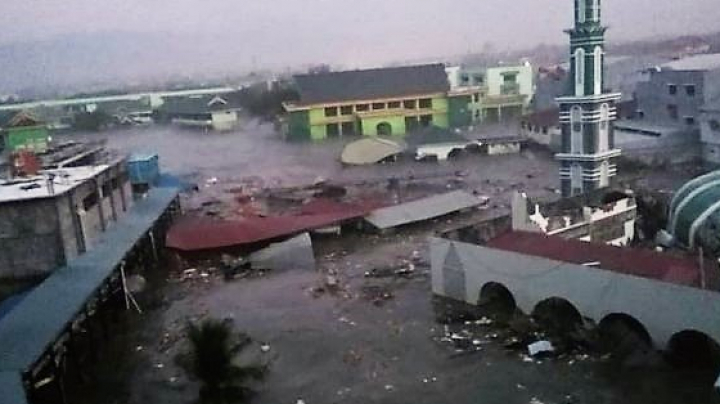
Palu Tsunami: Unhas Faculty of Geological Engineering Professor: As Predicted
Palu Tsunami, Unhas Geology Professor:
As Predicted
Sunday, September 30, 2018, 9:42 p.m.
Dr. Adi Maulana
Professor of
Geology
at Unhas, Dr. Adi Maulana, was stunned when a massive earthquake followed by a tsunami
struck Donggala and the Central Sulawesi region.
He
recalled the results of his research from about 10 years ago. In one of the chapters
of his dissertation, written about 10 years ago at Kyushu University in Japan,
titled “Petrology, Geochemistry, and Geochronology of Granitoid Rocks
from Sulawesi, Indonesia,” he decided to include a section on
“The Exhumation Process of Granitoid Rocks in Palu, Central Sulawesi.”
This
chapter was quite controversial, as its final conclusion was that the granitoid
rocks in the Sulawesi Neck—known as the Dondo Batholith—exhibit a
rate of exhumation, or uplift to the surface, that is significantly
faster than in any other region in the world.
This
exhumation process is responsible for the exposure of granitoid rocks—which
are, in fact, plutonic or intrusive rocks formed
deep within the Earth—and for the formation of Mount Dondo, which rises to a height of more than
2,000 meters. These granitoid rocks extend from the Palu area to Toli-Toli,
Central Sulawesi.
Based on
the results of electro-probe microanalysis (EPMA), particularly the mineral chemistry data for
plagioclase, biotite, and hornblende, combined with age data from
argon dating of biotite and hornblende, Maulana calculated
the geothermobarometry of these granitoid rocks. He concluded that
the exhumation rate of granitoid rocks around the Sulawesi neck,
particularly near the city of Palu, reaches 2.7 mm/year.
These
results indicate that the exhumation rate in the Palu area and its surroundings
is extremely rapid and is surpassed only by the exhumation rate of granitoids
in the Himalayan Mountains.
The conclusion
in that chapter is: _The rapid exhumation rate of the Sony Pluton (near Palu)
is attributed to the active vertical movement of the Palu-Koro Fault Zone, which
has been active since the Pliocene. This indicates that faulting may play an important
role in the differential exhumation of intrusive bodies within an orogenic belt._
"Based on
this conclusion, I hypothesize that the Palu-Koro Fault exhibits
vertical movement in addition to being predominantly described by many experts as
a strike-slip fault," wrote Maulana.
Ultimately,
this was proven when the Palu-Koro Fault moved and subsequently triggered
a tsunami, Maulana said.
“May
the people of Palu always be protected and granted the strength to endure
this disaster. May we be able to build a better and
more comprehensive system for disaster mitigation in the future so that loss of life can
be minimized,” Maulana expressed in his writing regarding the Palu Tsunami.
Currently,
Maulana is finalizing a draft paper that has been delayed for two
years on the tectonic evolution of Central Sulawesi based on geochemical
and geochronological data, particularly zircon dating data.
This
year, Maulana and several geologists from National Taiwan University—sponsored by
an international research consortium from Taiwan under the theme “Geology of the
Silk Road”—will collect even more data
on isotopes and zircon dating from all igneous rocks found in
Sulawesi.
This
research is expected to take approximately 5 years and is anticipated to produce a
more detailed tectonic model of Sulawesi for various purposes.