Four Unhas College of Engineering Faculty Members Lead the Patriot 2026 Expedition Team, Bringing Impactful Innovations to Transmigration Areas
The Hasanuddin University Faculty of Engineering has once again demonstrated its commitment to supporting national development through active participation in the 2026 Patriot Expedition Team (TEP). Pursuant to Decree of the Minister of Transmigration of the Republic of Indonesia No. 128 of 2026, four faculty members from the Faculty of Engineering have been appointed as team leaders to spearhead research and the development of innovative solutions in various transmigration areas across Indonesia. This participation serves as tangible proof that academic expertise can be translated into innovations that have a direct impact on communities and regional development.
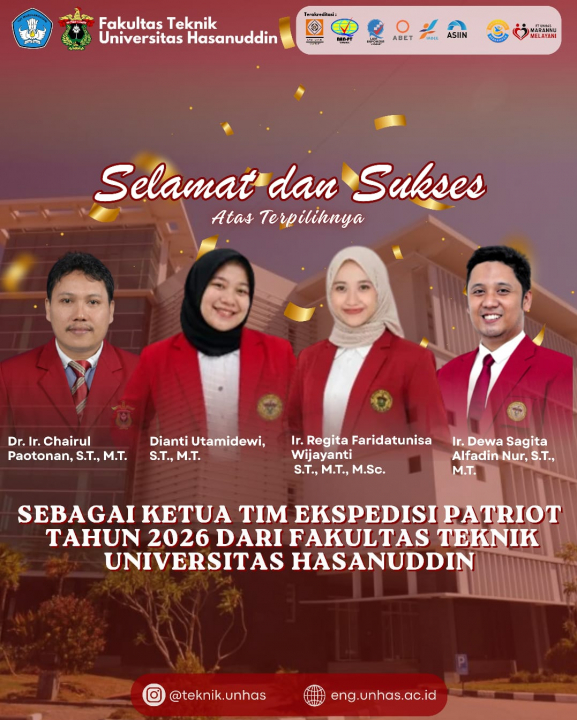
The four faculty members are Dr. Ir. Chairul Paotonan, S.T., M.T., assigned to the Anawua Transmigration Area in Kolaka Regency, Southeast Sulawesi; Dianti Utamidewi, S.T., M.T., in Weri–Saharey, Fakfak Regency, West Papua; Ir. Regita Faridatunisa Wijayanti, S.T., M.T., M.Sc., in Mahalona, East Luwu Regency, South Sulawesi; and Ir. Dewa Sagita Alfadin Nur, S.T., M.T., in Sidenreng Rappang Regency, South Sulawesi. Together with a multidisciplinary team from Hasanuddin University, they are contributing to a strategic program aimed at accelerating the transformation of transmigration areas into new, competitive, and sustainable centers of economic growth.
What sets the Patriot Expedition Team apart is not only its fieldwork but also the science- and technology-based approach it applies to address real-world challenges in the community. One example of the innovations they have championed is the development of a strategy to combat coastal erosion through a combination of structural (hard) and non-structural (soft) approaches tailored to local environmental conditions and involving community participation. This approach is expected to yield more adaptive, effective, and sustainable coastal protection solutions.
In the energy sector, a team from the Faculty of Engineering has also developed a model for utilizing distributed solar power plants (PLTS) to support public facilities while strengthening the downstream processing of nutmeg in the Weri–Saharey transmigration area. The concept of distributed solar power plants offers an energy supply system that is closer to users, thereby improving the reliability of electricity supply in areas with limited infrastructure while supporting local economic activities based on the region’s key resources.
Another innovation involves the implementation of geospatial-based digital agrarian governance in the Mahalona area. The team developed the Minimum Viable Geospatial Governance Product—a geospatial product that utilizes essential data and easily accessible technology to support decision-making. By leveraging tools such as QGIS, web browsers, and smartphones, this system enables more efficient management of spatial information without requiring complex technological infrastructure, making it widely adoptable by both local governments and the community.
Meanwhile, in Sidenreng Rappang Regency, the Faculty of Engineering initiated the development of a model for an Integrated Transmigration Economic Zone through the use of a Geographic Information System (GIS), downstream processing of flagship commodities, and the empowerment of business groups. This approach not only produced a feasibility study document for the area’s development but also designed strategies to strengthen supply chains, distribution, and marketing to increase the value-added of local products and enhance the economic competitiveness of the transmigration community.
Overall, the involvement of Hasanuddin University’s Faculty of Engineering in the Patriot 2026 Expedition Team underscores the importance of multidisciplinary collaboration in addressing development challenges. Together with teams from other faculties at Hasanuddin University, the approach developed integrates civil engineering, electrical engineering, and regional and urban planning to produce solutions that take into account infrastructure, the environment, digitalization, renewable energy, and community empowerment.
This program also offers new insights into how university research can be directly applied through the development of technical studies, planning documents, governance models, and data-driven policy recommendations. Thus, the resulting innovations do not remain merely academic outputs but become tools that local governments and stakeholders can utilize to formulate more effective development strategies for transmigration areas.
Furthermore, the involvement of Faculty of Engineering faculty members in the Patriot 2026 Expedition Team represents a concrete implementation of the “Campus with Impact” spirit, in which higher education serves as a driving force for social change through the application of science and technology. The various solutions developed are expected to improve the quality of life for communities, strengthen regional resilience against environmental challenges, optimize the utilization of local potential, and foster the emergence of new, sustainable centers of economic growth.
Moving forward, the Faculty of Engineering at Hasanuddin University’s contribution to the Patriot Expedition Team is expected to further strengthen the institution’s reputation as a center for innovation and technological development relevant to the nation’s needs. Through synergy among universities, the government, and the community, the research outcomes are expected to generate tangible impacts in supporting national development while realizing the vision of Indonesia Emas 2045.